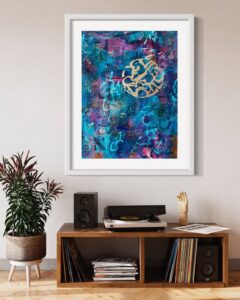
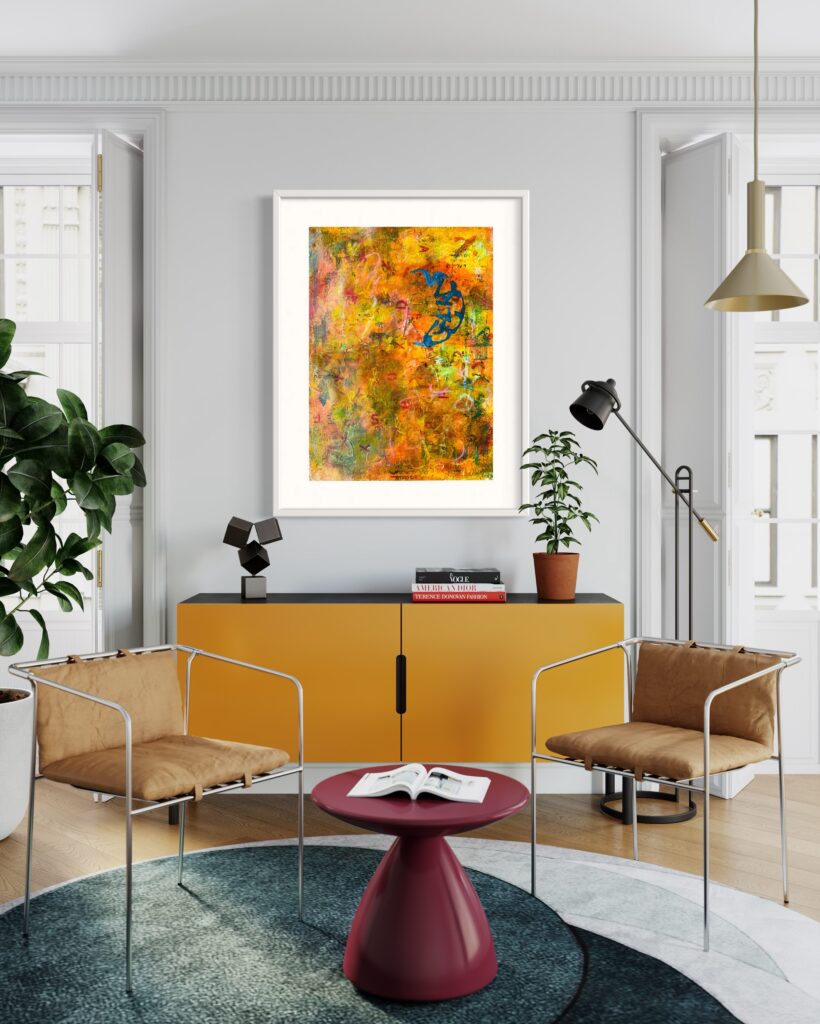
These Language Lessons pieces were made for a solo exhibition housed in the 1889 gallery in Liverpool which is housed in the building as a language school serving refugees and immigrants with business visas. At the time, from a desire to participate in synagogue services and understand more of the wisdom in the ancient Jewish texts, I began to learn Hebrew. Unlike the European languages I was force-fed at school, there was no common Latin base from which I might pull out the meaning of the words, no crossover as languages moved across arbitrary land borders sharing origins and referencing each other.
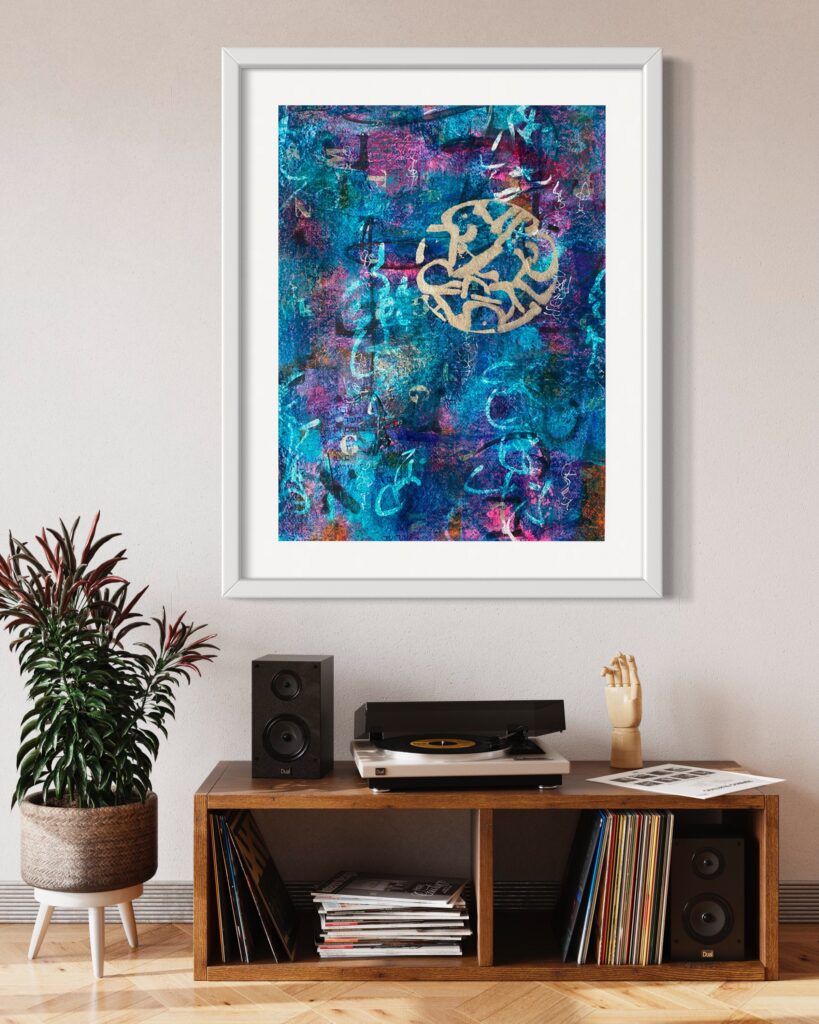
Worse, there was a whole other alphabet to grapple with before I even approached the unfamiliar declensions and root system. In the early stages I was assisted by a kind stranger who set up an internet site, intended for children but of blessed help for adults too. They took each letter and drew a cartoon shape around it making it memorable.
The gimmel ג with its splayed feet and perky cap was filled in to look like a sentry on duty outside a palace. G for guard for gimmel. Tsadi צwith its wriggling shape, ears at the top, body at the bottom became a collection of rats, the ’ts’ at the end of rats being the exact sound the tsadi brings to Hebrew. You get the idea. The ancient liturgy became littered with boats, lightning, hangman’s scaffolds and seat backs.
Emily, who volunteered to help me, added her own individual aids, passed down from Frank, her own teacher. The two parallel dots that form a vowel sound which his transliterated as ‘e’, had to be distinguished from the triangular set of three dots that also became the letter ‘e’ in English but was pronounced differently. To this day I see these marks and think, ‘two dots for two fingers and the sound you make when someone pokes you with them and you make a sound of objection, because you want them to stop’. Or, ‘three dots for Emily’s birthday being on the 3rd and three dots sounds like the E at the start of her name.’
Even with these quirky methods, the language continued to float randomly out of grasp. Just when I think I have memorised enough words to translate a passage, memory becomes overfull and a key word gets away from me. Or, I turn a page and a whole new vocabulary arises, or old vocabulary shape shifts as it moves to a different tense or gender because, yes, Hebrew has gendered words and gendered endings to adjectives and, inevitably, exceptions to all those rules. Siddur Hebrew is not quite Biblical Hebrew, is not at all modern Hebrew. Oh, and some of those texts? Not Hebrew at all but Aramaic. Thankfully the siddur – the prayerbook – has both transliterations and translations to make it intelligible from the start. Time and purpose are also on my side. I am in no rush.
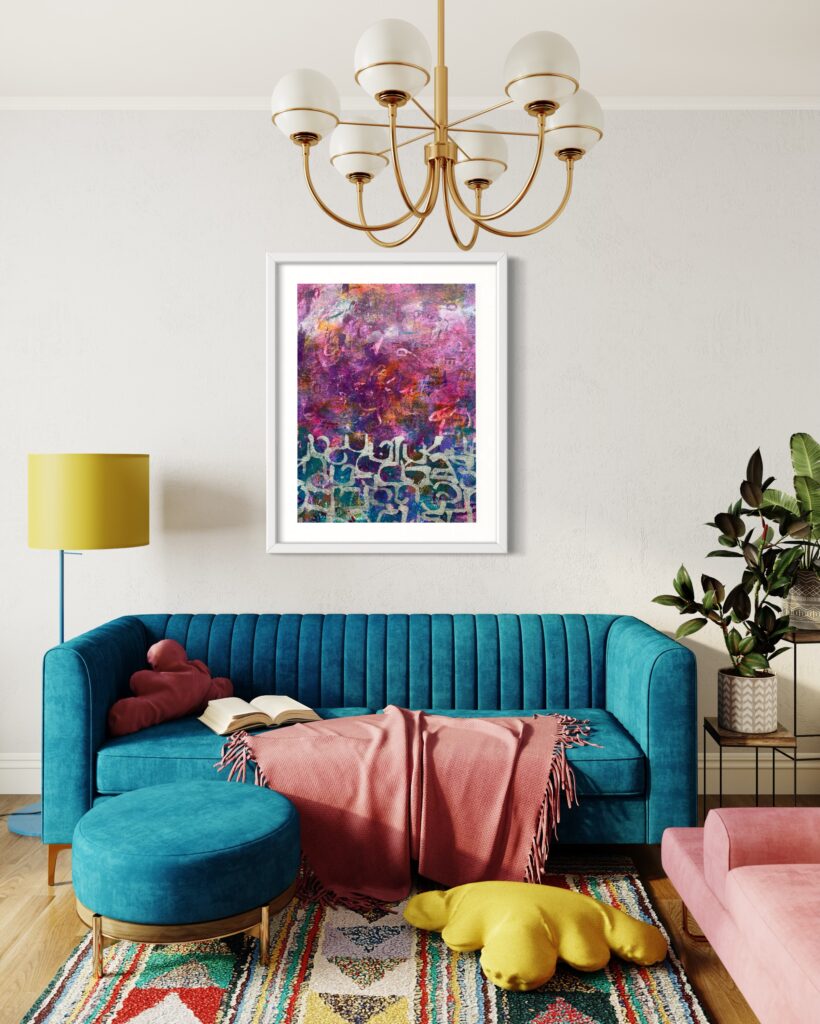
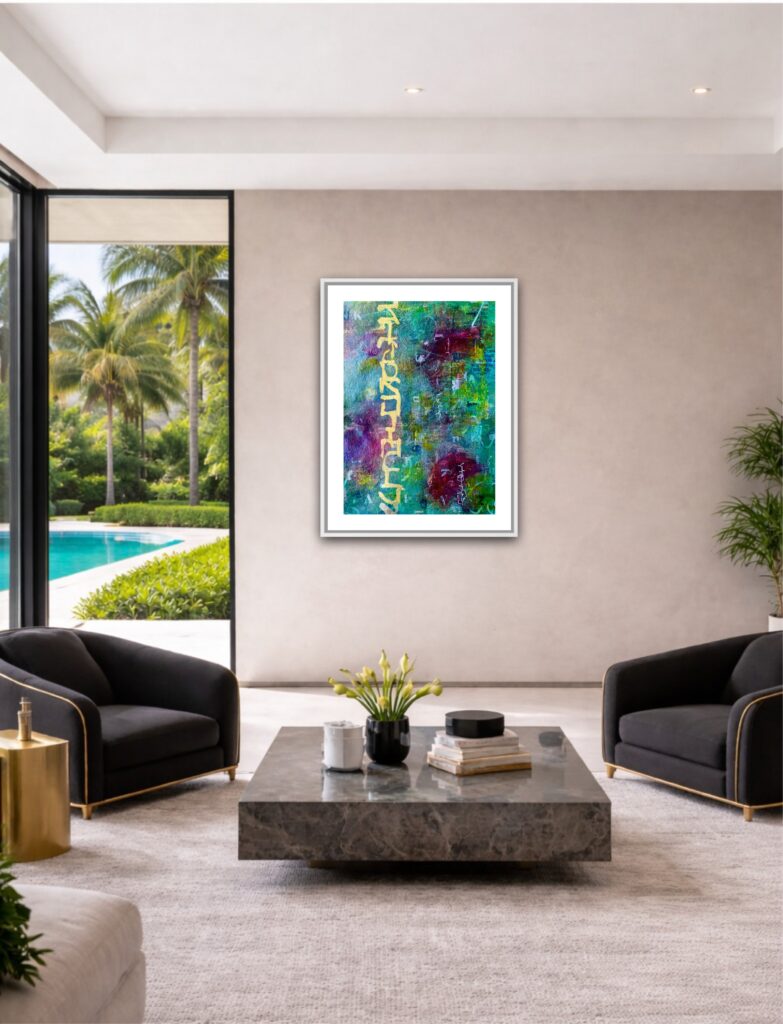
Unlike the Arabic, Ukrainian or Bengali speaking immigrants in the Gallery’s building, who have the same experience with English, my capacity to read Hebrew is not essential to my integration into a new society. The liturgy is in Hebrew, but it is translated, and the social conversations are in my mother tongue. My partial understanding does me no harm. For immigrants however, the way that a foreign language swirls and twists into unfamiliar shapes, surrounding you but never falling into recognisable patterns is more than a stimulating personal challenge. Without language you cannot read a bus destination, cannot engage in that British habit of discussing the weather, cannot choose packaged food easily. Ordering in restaurants, filling in job applications, reading the parking signs or the instructions on medication all become challenging. Watching films, ordering a round of drinks, paying for a ticket to ride the tourist ferry all become struggles not pleasures.
Language lessons are about more than mastering grammar and learning vocabulary. They are a path towards better mental health, upward social mobility, education, employment and friendships. Learning to be comfortable with abstract art can be the same as learning a language -the meaning is not immediately apparent, references not clear. In a still life familiar shapes and lines form recognisable scenes; two plates, wine bottle and a vase of dahlias. You understand at once. This is a story about a special dinner. Looking at an abstract piece and not immediately understanding why an artist has made seemingly random marks and splashes of colour can make us isolated from those who appear to do so, either because we feel we are missing out on a secret or because we choose to turn our backs and dismiss the abstract world because it makes us feel an outsider.
And yet, in the early stage of language learning there can still be communication. Tone and rhythm bring meaning, meaning which we often cease to listen to and appreciate once we can access the literal translation of words. In the same way abstract art can instil feelings and understanding in us if we give it a chance. Colour can evoke moods, lines and marks prompt memories. In both cases, the communication becomes less about concrete statements and more about our shared humanity, the places where we are different yet the same. The understanding comes not from the dictionary definitions of words, but from the unspoken experiences which underlie them.
The Jewish ‘mourners’ prayer’ – the Kaddish, read communally alongside those in bereavement – has a repetitively rhythmic passage. In transliteration it reads: yitbarach, v’yishtabah, v’yitpa’ar, v’yitroman, v’yi tnasei v’yit-hadar, v’yit’halal, sh’mei d’kudsha, b’rich hu. Once translated, it becomes apparent that the prayer has nothing at all to do with death, not mentioning it even once. It is a prayer of praise to God, a seemingly irrelevant and even provocative set of words for someone who has lost a loved one. But listen to the rhythm of the words. Say them with me even though perhaps you don’t understand them: Yitbarach, v’yishtabah, v’yitpa’ar, v’yitroman, v’y itnasei v’yit-hadar, v’yit’halal, sh’meid’kudsha, b’rich hu.
Do you hear in the beat the promise of continuity, the ongoing heartbeat, the promise that things will continue, that after this, this unbearable moment, there will be a beat and life will begin again? Can you imagine these rhythms repeated from at least twelve mouths alongside you, holding you in the cradle of their certainty, the repetition not just present in this moment in the room, but echoing throughout the ages from communities around the world?
Yitbarach, vyishtabah, v’yitpa’ar, v’yitroman, v’yi tnasei v’yit-hadar, v’yit’halal, sh’mei d’kudsha, b’rich hu.
You don’t need to know that you are saying the words, ‘gloried and celebrated, lauded and praised acclaim and honoured, extolled and exalted’ to get the feeling that the prayer is intended to give you. You are not alone, you will be able to go on.
Abstract art is not always immediately intelligible to viewers either, but it works the same way. Knowing the ’translation’ – the maker’s thoughts and intention when painting – might well give you added understanding. Hopefully reading this article is allowing you to look at my Language Lessons series in a new way.
Yet, it is not necessary for the viewer to know the thoughts or intentions of an artist for the two of them to have a communication. The design, balance, values, colours, lines in the art all operate under the surface to invoke a response. Indeed, the artists themselves may not be able to articulate fully their own intention until after the work when they reflect more fully on what came out of them. The viewer can have an interpretation the artist did not see, in the same way that in a conversation a listener will respond to something you say, prompting you to pause and admit “I didn’t mean that but yes, you are right’.
What do these pieces say to you?