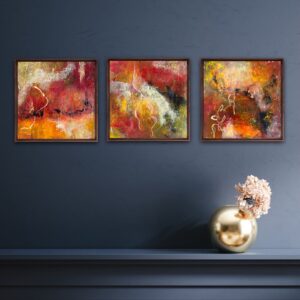
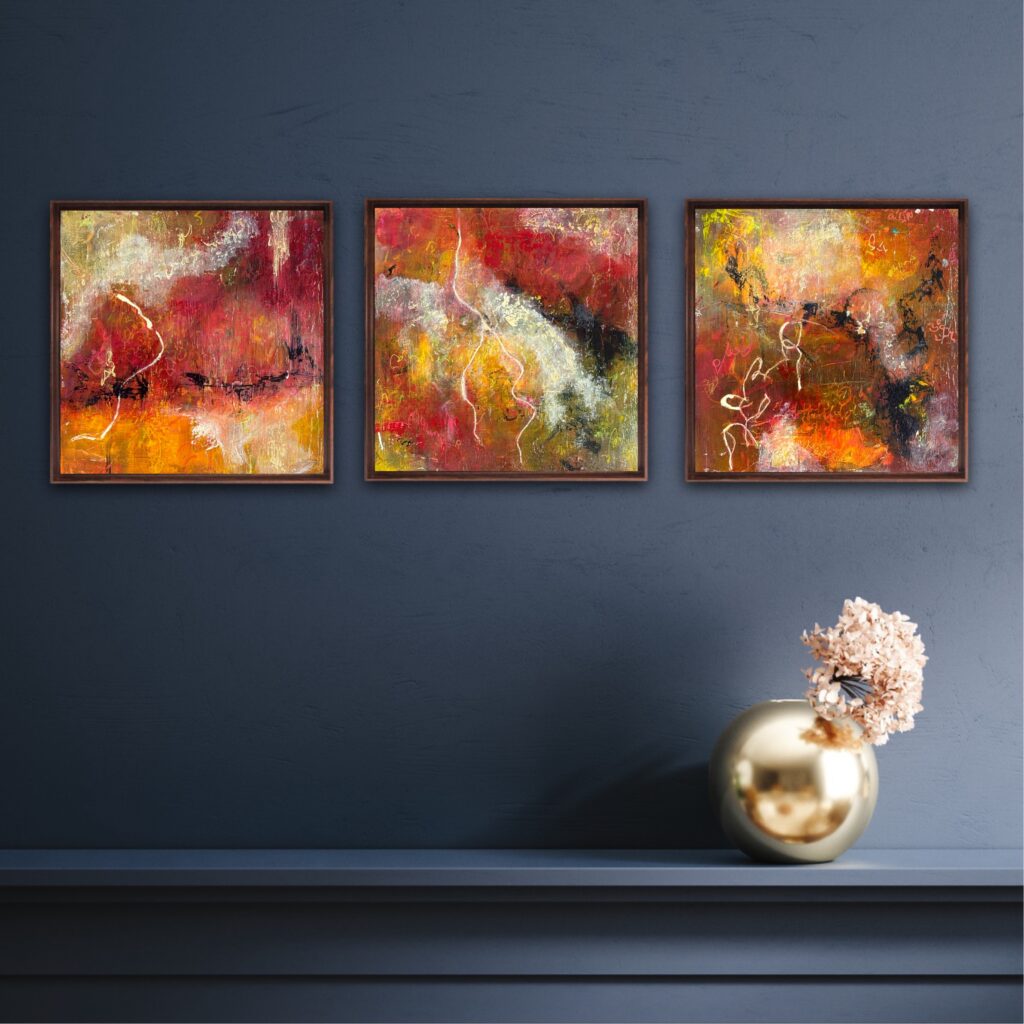
Where do you get your ideas? is a common question asked of all artists. There are many answers which range from those who take a laboriously mechanical route though direct observation and sketching to those who airily acknowledge the role of their unidentifiable muse. The question however presupposes that an artwork starts with an idea. As exemplified by the first three works in my series Standing at Sinai this is not always the case.
The Series title
The series title comes from the Biblical story, well known from Charton Heston’s performance as Moses, in which the Israelites stand at the foot of the Mount Sinai, trembling at the display of thunder, lighting and smoke, while the new law, including the Ten Commandments, is delivered from on high. It’s a dramatic scene that forms the creation of a new ethical and legal framework for a society and a new identity for the people. If it happened at all, it was over 3,000 years ago, yet the metaphorical term ‘to stand at Sinai’ retains relevance today.
Theologically it refers to the idea that spiritually all future Jews were also present at Sinai to receive and take on the new law. Creatively however it refers to the fact that the Torah is not static, it is a text that keeps on giving, providing a foil for discussion that leads to new revelations in every generation. But what if we do not believe in a God who speaks from the sky? Or what if we do, but we wish to experience the wisdom wrapped in this text in a non-religious sense?
Where do artists get their ideas?
Contained in this story we can see two answers to the question: How do you get your ideas? together with the answer to the question, What happens when you have no idea?
(a) the bolt from the blue
First, we have the inexplicable ‘bolt from the blue’ idea that seems to come from nowhere. When a curious non-artist asks how we thought of constructing a particular piece many times the only, unsatisfactory, response is, “I woke up thinking about it’ or, I was walking to the supermarket, and I suddenly had this idea!”. To a degree sleep science can explain how the brain makes connections in our sleep or why taking exercise or showering can create an environment in which we are more likely to have ‘eureka’ moments. Fundamentally, however, the process is inexplicable. It feels like a precious gift to be received, just as the voice from heaven started to speak the new Torah.
That said, the story mirrors the oft repeated artistic advice that the muse will only find you when you show up routinely to be met. In the Sinai story the thunder and lightning didn’t just appear. First there were days of preparation with the people milling about the wilderness, setting boundaries and preparing their clothes – not unlike artists carving out sacred time to paint and making sure their brushes are clean and paint delivered.
(b) the helpful other
Another form of idea generation is indicated in the role of Moses. The people quickly get scared by hearing directly from this thundering voice, or as we may read it, by the ineffable mystery of the creative process. They want something more familiar. So they ask Moses to be an intermediary, to go and hear the frightening voice and then come and tell them what it says. They step back and distance themselves from the source. As artists we may attend classes, or go to galleries or look at catalogues. We mediate our ideas via the experience of those who go before us, whether in the formal apprentice styles of Michaelangelo’s era or by the Internet wonder that is Pinterest.
There is no suggestion in this text that this is an inappropriate way of receiving ideas – in fact, the passing down of or joint exploration of knowledge and ideas is a fundamental part of both Biblical times and later Rabbinical Judaism. When as artists there are no bolts of lightning falling on our heads from ahigh, we can still access the creative energy that is already in the world and harness it for our own purposes.
Indeed sometimes we need assistance to be able to make sense of the bolt from the blue ideas. Rabbi Avivah Gottlieb Zirnberg in the book Moses: A Human Life, looks at this desire of the Israelites to run away from the inspiration source in psychological terms, writing that,
“the people’s impulse to delegate the experience to Moses represents a flight towards closure. Sinai is the half-open door, an invitation… to find a place in which they can be with the Divine. Their inability to hold such an open/closed position represents a dilemma in the spiritual-erotic life of the huma being.’
Certainly the need to hold the discomfort between not-finished/ finished or total mess/gorgeous is the life of the artist. Having a coach, tutor or mentor that can model how to do that is a gift.
At this stage then, the Israelites have enough direct experience of the thunder to feel inspired and enough support and technical information to understand what the new project is about. However, the story doesn’t end there.
(c) by doing we understand
The next day Moses, got up, set up an altar, engaged the people in a ritual (we might say prepared them psychologically and emotionally to be creative) and then read them the manual. The people then say, v’aseah v, nishmah: we will do and we will understand.
Creatively, the real understanding of what our art is to be about comes from the doing. The process is the crucible in which the revelation emerges. We can sit at the feet of master’s and listen to them talk about art and read as many user instructions as we like. Until we get in the studio and make, we will not understand either how to do the art or what it is we are being called to express through that art.
The story and meaning of the Standing at Sinai series
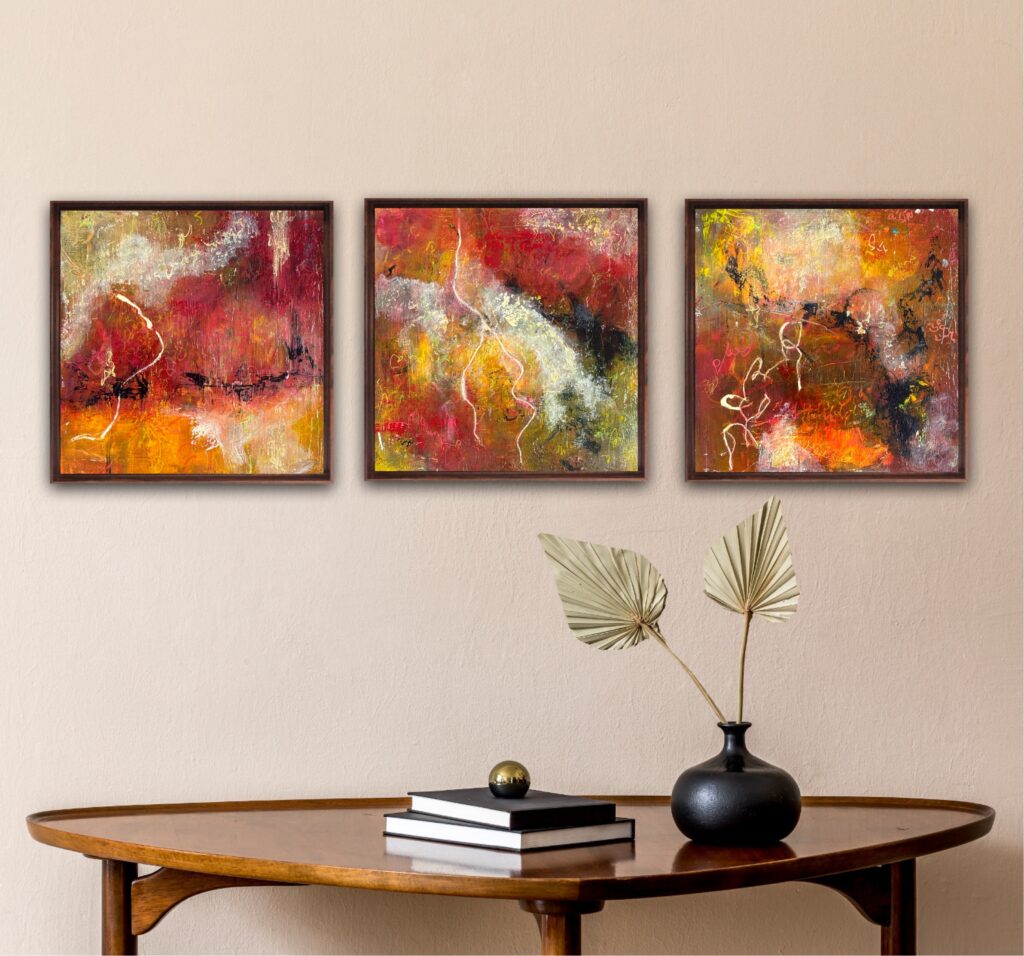
The first three works in this series were made though play, with no clue what the end result would be. Indeed, when it was finished, I felt a dissatisfaction with them because I didn’t understand them. I could see that visually they were finished but without being able to attach some meaning to them I felt disconnected from them. This only changed when I left them I my studio and went a study session lead by my Rabbi Kath Vardi where she challenged us to look closely at the text. It actually says that the people saw the thunder. What does that mean?
There are many medieval commentaries suggesting the happenings at Sinai were so momentous that people’s senses got mixed up and they experienced a kind of synaesthesia. What does it mean in the context of continual revelation, however? Perhaps it is a reminder that visual art has a part to play in helping people see and experience a point, and therefore understand it better than they might from simply being told it. Visual art can be a powerful entry point to understanding. Perhaps one role artists hold is to help viewers experience revelation. Not necessary in the sense of deep new theology or word altering fresh ideas, but in the sense of the revealing of what lies deep within us and gets hidden by the noise of daily life; the beauty of a seascape, the calmness of a full moon, the ability to sit with a difficult social issue and feel that it is manageable. Our own desire to create, the message we are called to share, the bravery to do so.
It works the other way round too. Making these pieces and then reflecting on what I had created led me to be open to considering an ancient text in an entirely new way. I wonder what you see in them?
If you are interested in the idea of art aiding understanding in a Jewish context, see Rabbi Rachel Barenblatts’ work on visual liturgical arts for our times. If you are interested from a psychological point see this article).